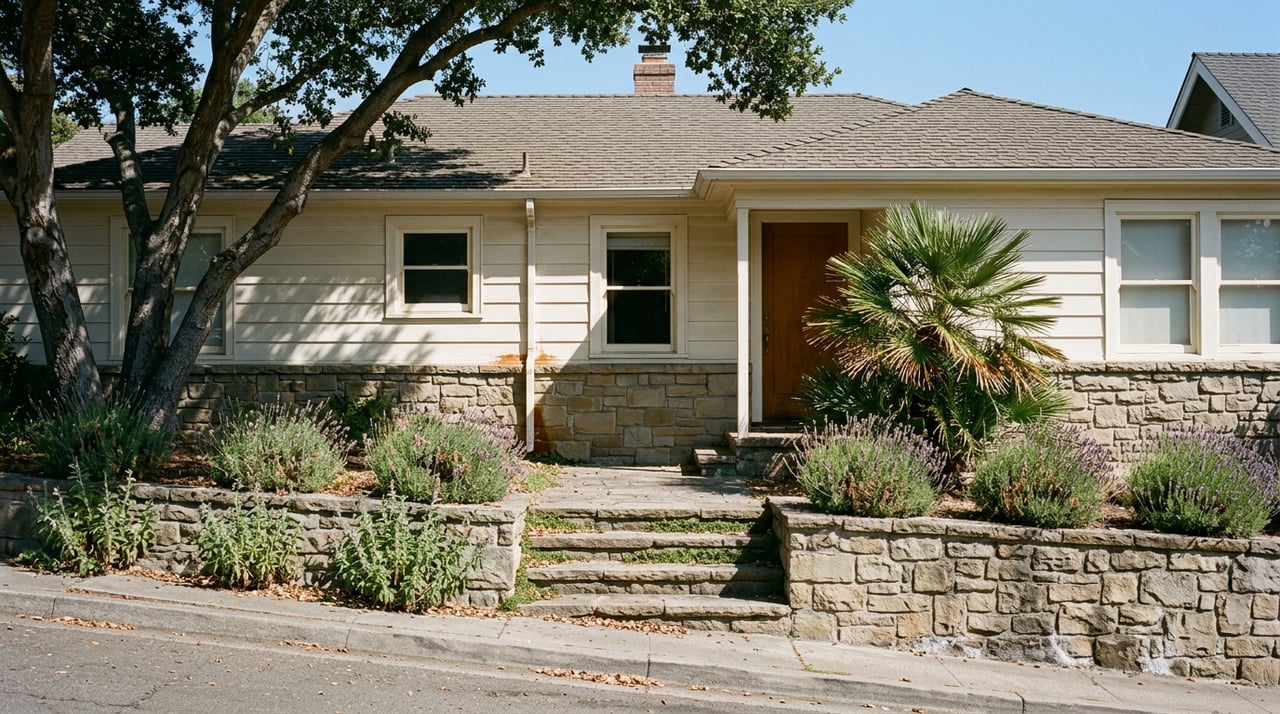
The Gas Station on Palmer Avenue Has an Annual Budget. Here's What It's Funding Right Now.
August 20, 2026
August 20, 2026
If you've driven the corner of Palmer Avenue and Adams Street in Adams Hill more than a few times, you've clocked the building without registering it. It's the little curved-corner structure with the flat overhang, the one that still reads as a 1930s drive-in even though no one has pumped gas there in decades. Most people file it under "cute old building the city fixed up" and keep driving toward Chevy Chase or the 134.
That filing is incomplete. The gas station at 1020 East Palmer Avenue isn't a preserved artifact sitting quietly behind glass. It's a functioning line item. The City of Glendale's Arts and Culture Commission runs it as a working gallery with a real annual budget, a standing call for artists, and a rotating schedule that changes what's inside roughly seven times a year. Right now, through October 2, that budget has bought Adams Hill a family of oversized hand-formed figures that most residents haven't seen yet.
The building went up in 1936 in the Streamline Moderne style, all rounded edges and horizontal lines meant to suggest motion even while parked at a curb. It served as an actual gas station for decades before falling out of use, the way corner gas stations across Southern California did once bigger, faster stations along the boulevards took over that business. Rather than tear it down, the city folded it into a new pocket park completed in 2007, on a lot under a third of an acre, and kept the structure intact.
What makes the building unusual isn't that it survived. Plenty of old commercial buildings survive by getting turned into plaques or historic markers people walk past without entering. This one survived by staying useful. The interior is a roughly twelve-by-twelve-by-twelve-foot cube with acrylic windows, two doors, two electrical outlets, and a timer. Artists can hang work from the ceiling. It's a real exhibition space with real constraints, not a diorama.
The Arts and Culture Commission curates the gas station's schedule and keeps the call for artists open year round, reviewing submissions each spring. The commission allocates roughly $18,000 a year to the program, spread across about seven rotating exhibitions.
The per-artist economics are specific enough to repeat exactly:
Each selected artist receives a $1,000 stipend plus up to $1,500 in production budget, for a maximum total of $2,500 per installation.
That's a small number by gallery standards, but it's a real number, funded through the city's Urban Art Program and coordinated with Glendale Community Services and Parks. It means the rotating shows aren't hobbyist favors. The artist who had the space before this summer, A. Laura Brody, has thirty years of experience as a costume designer whose credits include LMFAO, the Black Eyed Peas, Rihanna, Netflix, Disney Imagineering, the LA Opera, and Diavolo Dance Theatre. Her installation, Phoenix Rising, ran from January 12 through March 20, timed near the one-year mark of the Los Angeles wildfires, and was built from donated clothing left over from that disaster, cut into irregular shapes and sewn into a room-sized garment meant to read as rebirth through fire.
That's the caliber of work this twelve-foot gas station bay has been drawing. It's worth knowing before you decide whether the current show is worth the walk.
Since July 13, the gas station has held Gentle Giants, an installation by artist Raphaele Cohen-Bacry. The piece is a cluster of tall, hand-formed figures gathered like a loose family, sharing the small space with smaller companion forms suggestive of birds scattered among them. The Adams Square Neighborhood Association hosted an artist reception on site on July 19.
The show closes October 2. That gives residents roughly six weeks from today to see it before the next rotation replaces it, and given how quickly these installations turn over, six weeks is not a long runway if you keep telling yourself you'll swing by eventually.
The park around the gas station is small, under a third of an acre, but it's built for combining stops rather than standing alone. If you're already in Adams Hill on a weekend morning, the loop looks like this:
None of this requires a special trip. It's a loop that fits inside a Saturday errand run, which is probably why the reviews people leave about this park tend to mention passing by on an evening walk rather than making a deliberate visit.
The more interesting decision here isn't that Glendale saved a 1936 gas station. Cities save old buildings all the time and then let them sit as static history, a plaque and a photo op and nothing else. What the city did instead was harder and less common: it kept the building doing something. It gave the Arts and Culture Commission an actual budget, gave artists an actual stipend, and gave the neighborhood an actual reason to check back every few months instead of once.
That distinction matters if you live near it. A landmark you visit once and a gallery you check quarterly are different relationships to a piece of your own neighborhood. The gas station on Palmer Avenue is the second kind, and most of the people who drive past it daily still think it's the first.
If Gentle Giants is still up when you read this, the window to see it closes October 2. After that, whatever comes next will have its own opening, its own artist, and its own six-week countdown that almost nobody will notice until it's nearly over.
We spend our days at Character Homes paying close attention to the small, specific things that make one Glendale block different from the next, whether that's a preserved Streamline Moderne roofline or a rotating art program tucked inside one. If you're curious what else makes a particular corner of Glendale worth knowing before you buy or sell there, that's a conversation we're always glad to have.
Stay up to date on the latest real estate trends.
When you’re ready to make a move — we’re here to make it meaningful, seamless, and fully aligned with your goals. From first steps to final signatures, we’re by your side