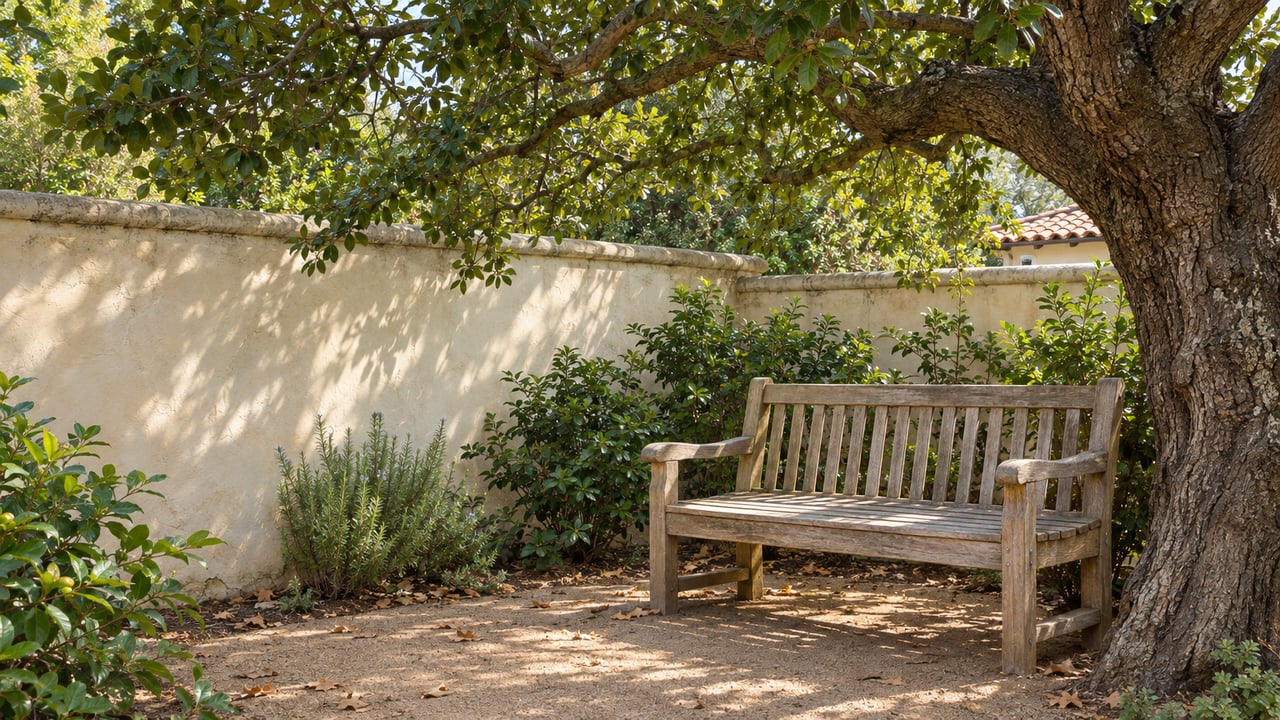
Inside the Catalina Verdugo Adobe, Glendale's Oldest House With an Unsettled Birthday
November 19, 2026
In 1931, Dora Verdugo Bullock opened a small restaurant in the big backyard of her home on Verdugo Road. Diners ate her homemade tamales at tables set under the trees, and her land ran down to the creek that is now the concrete Verdugo Wash. That account comes from Katherine Yamada's Verdugo Views column in the Glendale News-Press, as collected by The Glendale Historical Society. Dora was born in 1882 in the adobe on Bonita Drive, and she spent her childhood there. For the rest of her life she pushed back on the history that had grown up around that house.
"It was built by my father, Teodoro Verdugo, some time around 1860," she wrote in a letter to the Glendale News-Press, quoted in the same Historical Society retrospective. That date matters more than it first appears. The adobe at 2211 Bonita Drive is best known for the Oak of Peace, where Mexican and American emissaries are said to have agreed on surrender terms in January 1847. If Dora was right, the house did not yet exist when that meeting happened under the tree 30 yards away. The adobe would then be the second-oldest story on its own lot.
The City of Glendale lists the building as the Catalina Verdugo Adobe and calls it the oldest structure in the city. The City's historic facilities page gives the founding story briefly: "It is said the Adobe was built in 1828, but some research suggests that it dates to 1860." The state's California Historical Landmark No. 637 listing gives a third answer, the 1830s.
The name has its own history. Catalina was the daughter of Don José María Verdugo, whose grazing rights on Rancho San Rafael were approved in 1784, with official title following in 1797. The City's Oak of Peace page puts the rancho at 36,403 acres covering present-day Glendale, Burbank, La Cañada Flintridge, Los Feliz, Eagle Rock, Highland Park and West Pasadena. According to the Historical Society's account, Teodoro, the son of Catalina's brother Julio, built the adobe and invited his aunt to live there with his family. Catalina was the better-known Verdugo, so the neighborhood called it the Catalina Adobe. In 1947, Native Daughters of the Golden West Parlor No. 247 made that name official.
Dora did not let it rest. After her letter, the Old Settlers Association of Glendale formally backed her and adopted a resolution that the house be known as the Teodoro Verdugo Adobe Casa. That name never stuck.
Bruce E. Medcalf, a planning assistant for the City of Glendale, took up the question in the 1970s National Register of Historic Places nomination for the site. It opens the section on the adobe by saying "a mystery surrounds the identity of the builder and the date of construction." Over the years the builder had been named as Don José, Catalina or Julio. The nomination found it impossible to prove either version, because property transactions on Rancho San Rafael in the 1800s were "in many cases contradictory and confusing." It also points out that in early California, even prominent people often could not read or write and distrusted written documents. The site went on the National Register as San Rafael Rancho on December 12, 1976.
The Oak of Peace story holds up whichever date you accept for the house. The City's account says General Andrés Pico had taken refuge on the Verdugo rancho after heavy losses at the battle of San Pascual. On January 11, 1847, Lt. Col. John C. Frémont sent Jesús Pico to him with a letter of surrender terms. Jesús convinced the general that larger U.S. forces were closing in from the north and the south. Two days later, Frémont and Andrés Pico signed the Treaty of Cahuenga at Campo de Cahuenga, which stood on present-day Lankershim Boulevard across from Universal Studios.
The City describes the oak in 1847 as the most visible landmark on the whole rancho, and it was already about 300 years old. Glendale's own register lists the two separately. The adobe is Register No. 1, the Oak of Peace is No. 2, and Casa Adobe de San Rafael on Dorothy Drive is No. 3. If Dora's 1860 date is right, the tree was the older of the two by more than a decade, and the house was built beside a landmark that was already famous.
The original oak died of root rot in 1987, and remnants of it are still at the original site. In 2023, the Don José Verdugo Chapter of the National Society Daughters of the American Revolution and the City of Glendale planted a new Oak of Peace. The City held a public dedication on October 22, 2023. According to Crescenta Valley Weekly, Burbank resident and DAR member Amy Toczek led that project with the City. So on a visit you can see the old tree's remnants and its young replacement on the same lot, both a short walk from the porch.
The house has an ownership trail. Teodoro Verdugo died in June 1904, and the adobe and its land were sold later that year. Developer F.P. Newport later owned it and, according to the City, took care to preserve it. In 1946, Dr. Ernest Bashor and his wife Jane, of Silver Lake, bought it as a future retirement cottage.
The Bashor family's own account, told to the Glendale News-Press and collected by the Historical Society, is the most vivid. A century-old rose bush had grown through the tar paper roof, so they reroofed the house in cedar shingles. They used the adobe for family gatherings until Ernest Bashor died in 1969. Jane Bashor moved in two years later, and the City bought the adobe and part of the land in 1989, a year after her death.
The National Register nomination, drawing on the owner and City building records, says the original adobe walls were left mostly as they were. The changes were plaster inside and out, stronger floors and modern plumbing. The largest change came in 1946: a north wing with a dining area, a wood-paneled kitchen, a dressing room and a large picture window. The nomination says the window "does violate somewhat the integrity of the adobe" but that the addition blends in well overall. Together the adobe and the addition total 1,458 square feet. On a tour, that wing is the clearest dividing line in the house: the main room and south wing on one side, and a postwar retirement cottage on the other.
The 1.3-acre park at 2211 Bonita Drive, near Opechee Way, is open daily from 7 a.m. to 10 p.m. The grounds have a walking trail, a garden and a shaded picnic area with wooden tables. Smoking, barbecues and amplified sound are not allowed because the site is historic. The house itself opens only for guided tours, held on the first Sunday of each month from 1 to 3 p.m. There are no tours on holidays or in bad weather. On the current calendar, the next first Sunday is December 6, and the City's information line is (818) 244-2841 if you want to confirm before you go.
The City lists the Days of the Verdugos Heritage Association as the tour docent. Crescenta Valley Weekly reported last December that the Don José Verdugo Chapter, NSDAR, has made the adobe its preservation project and trained its own members as docents for monthly tours. The chapter was founded in La Cañada Flintridge in 1953. On December 7, 2025, it held a Feliz Navidad celebration at the adobe and dedicated a new timeline sign on the history of Rancho San Rafael. The paper called this Phase II of the chapter's work there, after the 2023 oak. The same event included carols from the Crescenta Valley High School choir, folklórico dancers from Burbank, and a children's scavenger hunt run by Boy Scout Troop 319. The timeline sign is now on the grounds and is a good place to start before the docents open the door.
The same first-Sunday hours apply at Casa Adobe de San Rafael, 1330 Dorothy Drive, whose grounds are open from 7 a.m. until an hour after sunset. The City lists Stocker Street as its cross street. The Historical Society notes that a member of the extended Verdugo family built it. You can see both of Glendale's surviving adobes in one afternoon, which lets you set the Bonita Drive house beside another Verdugo-era home before deciding whose date you believe. For more on the streets around the Bonita Drive park, our Verdugo Woodlands neighborhood page has more. Our post on Nibley Park in Rossmoyne covers another Glendale park that holds its own place in the city's preservation record.
If your own Verdugo Woodlands house has a disputed build date or a 1940s wing with a story behind it, G&C Properties would like to hear about it. Contact us to discuss your character home.
Stay up to date on the latest real estate trends.
When you’re ready to make a move — we’re here to make it meaningful, seamless, and fully aligned with your goals. From first steps to final signatures, we’re by your side