Glendale's Newest Mills Act Contracts Come With a To-Do List Written for Each House
November 12, 2026
November 12, 2026
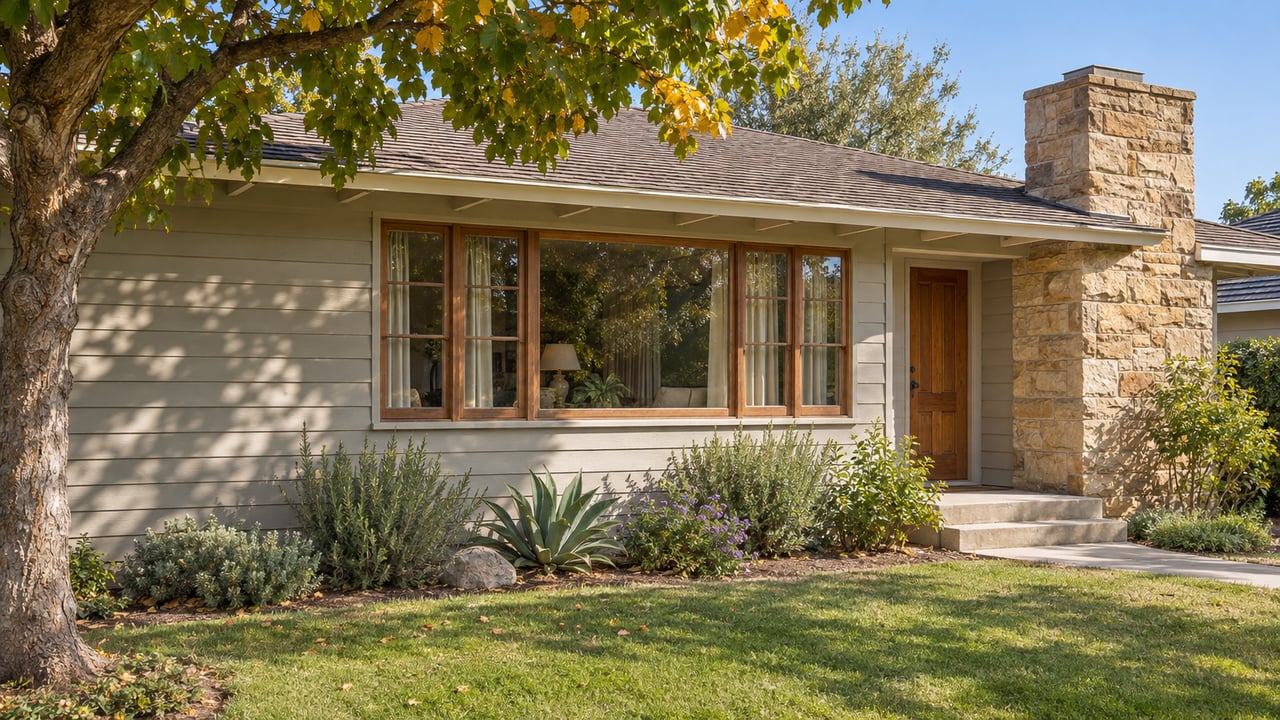
On a hilltop lot above Campbell Street in Rossmoyne stands a 1935 Colonial Revival. Its stone facade runs from the foundation up to the second-story windowsills. Leaded diamond-pane glass fills its two bay windows, and two oval windows sit in circular stone surrounds. At some unknown point, someone added aluminum decorative shutters. If the owners get the Mills Act contract they've asked for, those shutters have to come off within one year.
That proposed condition would sit in a document built to outlast the owners who request it. Glendale City Council had three owner-requested Mills Act nominations on its Nov. 10 public hearing calendar. Each one came with its own list of work, written by the Historic Preservation Commission for that one house. State law binds every later owner to the contract. So if you buy a Mills Act home in Glendale, you take over a specific set of obligations along with a lower tax assessment. Those obligations differ from one address to the next.
The Council staff report for the Lawson House describes a property with "a high degree of historic integrity." The only change it flags is the shutters. The other two houses on the calendar had different histories, and their conditions differ to match.
| House | Built | Neighborhood | Commission vote | Recommended contract conditions |
|---|---|---|---|---|
| Lawson House, 1625 Campbell St. | 1935, American Colonial Revival | Rossmoyne | 4–0 on Aug. 20, 2026 | Remove the aluminum shutters and repair walls as necessary |
| Lankford House, 1559 N. Pacific Ave. | 1930, Spanish Colonial Revival | North of W. Kenneth Road | 5–0 on Sept. 17, 2026 | Replace the aluminum garage door with a more compatibly styled wood door |
| Dr. Dean and Lillian O'Neil House, 3127 San Gabriel Ave. | 1952, Cape Cod subtype of Colonial Revival | Verdugo Woodlands | Unanimous on Oct. 15, 2026 | Five items, from window and door restoration to exterior lighting |
The Lankford House shows how narrow these lists can be. Its owners had already done work the city considered appropriate. A 407-square-foot rear family room was permitted in 1990, and staff found it inset and not visible from the street. New wood windows went in under 2010 permits, and the report calls them appropriate in "material, size, profile, operation, and details." That left one item, the aluminum garage doors that imitate carriage-style doors. Lloyd M. Culver built the house in 1930 for $8,000 for Arthur H. Lankford, who in 1916 became the city's first full-time salaried fire chief. He also flew a surplus Army plane painted red with "Glendale Fire Department" on it to scout hillside fires.
The O'Neil House has the longest list. The commission recommended these five conditions:
The shutters show how closely the commission reads a house. Staff noted that shutters are common on Cape Cods and may be appropriate. The placement on the north second-story window looked awkward, though, and a leftover mounting bracket on the south side suggests a shutter once hung there. Citizen Portal's account of the October hearing describes commissioners settling on keeping the first-floor shutters and removing the ones on the second story.
The O'Neil House was built in 1952 for a little under $15,000, with Dr. O'Neil listed as owner-builder and the Beauman Company of Pasadena as contractor. Staff found no notable historical figure or event connected to the house. Its case rests entirely on Criterion 3, as "an excellent example of the Cape Cod subtype of the Colonial Revival style constructed in the postwar era."
That has a practical side for buyers and sellers. Eligibility depends on style and integrity, so the conditions focus on whatever has weakened that integrity. The O'Neil list names the features that make it a Cape Cod: multi-light wood windows, wide wood board siding, the louvered shutters by the entry. The Lawson House qualified the same way, as an exemplary Colonial Revival. Staff traced its design to architect Allen Ruoff through a misspelled 1935 retaining-wall permit and a 1935 volume of Southwest Builder and Contractor. Its later owner John M. "Jack" Lawson served as Glendale's mayor in the mid-1950s. In all three cases, the parts of the house that made it eligible are the same parts the proposed contracts would require owners to look after.
Glendale's own process starts this way. The city's Mills Act application form asks owners to list the work they plan over the next ten years and estimate when each item will be done. The Historic Preservation Commission reviews the application and makes a recommendation, and City Council holds a public hearing and decides. After that, California's Mills Act statute sets the terms:
Put those rules beside the three work lists. Suppose a Mills Act house sells in its third year and the garage door is still aluminum. The buyer now holds that obligation, along with the five-year inspection schedule and exposure to the 12.5 percent fee if a breach leads the city to cancel. Since the auto-renewal keeps the contract running at least ten years ahead, nonrenewal notice doesn't end it quickly either. The California Office of Historic Preservation describes the periodic inspections as compliance checks.
The LA County Assessor revalues a Mills Act property every year using a statutory capitalization method. It then enrolls the lowest of three figures: the restricted value, the current market value, or the factored base-year value. The restricted value starts from fair rent minus allowable expenses, divided by a capitalization rate. For an owner-occupied single-family home, that rate adds a 4 percent historic-property risk component to interest, property tax and amortization components. The Assessor says Mills Act values can be considerably lower than the other two figures. The city expects the savings to be large enough to note. Each staff report says Mills Act tax savings will "slightly reduce City property tax revenues."
Because the result depends on a rent estimate and a formula that is recalculated every year, a seller's current tax bill tells a buyer about this year, not the next. When the house sells, the Assessor asks for the standard Preliminary Change of Ownership Report with the recorded transfer.
This post is general information, not legal, tax or financial advice. Please confirm how any contract or assessment applies to your property with an attorney, tax professional or the city's preservation staff.
The Glendale Register roster updated in March 2026 marks 105 entries in its Mills Act column. If you're shopping among older homes, you may come across one. These questions follow from how the three proposed contracts were drafted:
When does Glendale take Mills Act applications? The city's form sets July 31 as the deadline to ensure recordation by December 31. Later applications are accepted, but year-end recordation isn't guaranteed.
What does it cost to apply? The fee has to be paid before the application is processed. The form directs applicants to preservation staff for the current amount.
Does a house have to be on the Glendale Register first? Each of the three Nov. 10 items paired a Register nomination with a contract request, and the application form asks whether the property is listed or when its nomination was submitted.
If you own a Glendale house that might qualify, or you're looking at one that already has a contract, G&C Properties can go through the nomination, the conditions and the inspection history with you before you commit. Let's make it personal. Contact us to talk through the work list attached to your character home.
Stay up to date on the latest real estate trends.
When you’re ready to make a move — we’re here to make it meaningful, seamless, and fully aligned with your goals. From first steps to final signatures, we’re by your side